One year into Revive Our Ocean, a global community of practice is rewriting the playbook for coastal marine protection.
In 2022, something extraordinary happened.
For the first time in human history, over 190 countries came together around a single, shared goal: to protect at least 30% of the planet’s land and ocean by 2030. Known as 30×30, this landmark commitment—adopted under the Kunming-Montreal Global Biodiversity Framework—offered a roadmap to restore the natural systems that sustain all life on Earth.
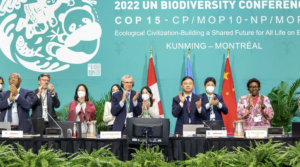
It was a moment of exhilarating and wise global alignment. A recognition that without nature, there is no prosperity. No economy. No us.
But behind that optimism was a sobering reality.
At the time of the agreement, only around 3% of the ocean was fully protected. While the science is clear, and effective marine protection works, the path to scaling remained uncertain.
The question wasn’t whether we could revive the ocean.
It was how we could do it—fast enough, and effectively, at scale.
The story of Revive Our Ocean began long before we launched last April 2025.
In 2012, Kristin Rechberger founded Dynamic Planet with a simple question but grand challenge to traditional markets: could we build economies that restore nature, rather than deplete it? At the time, this idea was often met with skepticism. Could conservation and economic growth truly go hand in hand?
Over the next decade, Dynamic Planet worked across landscapes and seascapes, partnering with governments, financial institutions, NGOs, and local communities to put this question to practice in effort to develop ‘conservation economies.’
Time and again, when intentionally designed and applied effectively, the answer was yes.
From protected landscapes in Africa to marine reserves around the world, a pattern began to emerge. When nature is restored, it creates value: ecological, social, and economic.
Nowhere was this more evident than in the ocean.
Through a long-standing collaboration with Revive Our Ocean’s co-founder, National Geographic’s Pristine Seas, Kristin Rechberger—CEO of Dynamic Planet and Founder of Revive Our Ocean—helped build one of the most ambitious marine conservation efforts in history. Since its founding in 2008, Pristine Seas has conducted 50 expeditions to date and helped establish 33 of the world’s largest marine protected areas (MPAs)—from Chile to Palau to the Arctic.
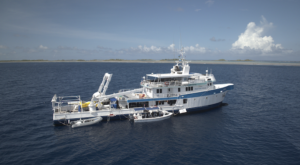
Pristine Seas was invited by governments and worked with communities to support their 30% ocean protection commitment: Chile, Costa Rica, Colombia, the Azores (Portugal), UK Overseas Territories, Seychelles, Palau, and Niue. They demonstrated that large-scale protection is possible and that marine life rebounds quickly, replenishing the areas inside reserves and beyond with a triple win for tourism, fishing, and climate mitigation. And Dynamic Planet’s job was to help explore, align and secure sustainable financing for some of these places until, ideally, they might be abundant and well-managed enough to pay for themselves.
But they also revealed something else.
Coastal waters, where most people live and depend on the ocean for food and livelihoods, and where the majority of ocean biodiversity lives, remained largely fragmented, small, and unprotected.
If 30×30 was to be achieved, it would also depend on a great number of effective coastal reserves and those communities who rely on the sea to help create and implement them.
A single question kept emerging: if marine protection is so effective—if it restores fish populations, strengthens ecosystems, and improves livelihoods, why hasn’t it scaled?
The team at Dynamic Planet behind Revive Our Ocean was eager to find out if we could combine our experience of what worked for MPA creation and implementation closer to shore—and contacted those known for creating the most successful coastal MPAs. We discussed their origin stories, current needs, and how they would scale to 30×30 in their countries. It was interesting to hear that each MPA had originated by a passionate and dedicated community organizer—a fisher, environmentalist, local administrator—some community champion who knew marine life was worth far more alive in the long run than dead in the short term and wanted to fight for the long run.
Over the course of 2023, Dynamic Planet conducted interviews with more than 30 leaders managing successful coastal MPAs across 10 countries; steadfast and solution-focused practitioners who had already proven that marine protection works to replenish marine life—boosting tourism inside reserves and fishing around reserves—succeeding often against great odds.
Despite vastly different geographies and cultures, their answers converged and informed the mandate for Revive Our Ocean.
What Coastal Leaders Told Us
Three clear barriers emerged, repeated across regions, contexts, and cultures:
Many communities and decision-makers simply don’t know the benefits that effective MPAs deliver. They don’t see them as tools for abundance and coastal prosperity, only as restrictions and limitations.
Even when communities want to act, governance frameworks often prevent them from creating and managing their own MPAs.
Most MPAs are not designed to sustain themselves financially. Yet the evidence shows they can generate significant economic returns, through tourism, fisheries recovery, and more.
These weren’t abstract challenges. They were practical, solvable barriers.
They pointed to a deeper insight: scaling marine protection isn’t just about conservation. It’s about designing systems that work for local people and economies, where local beneficiaries can reinvest back into the ecological system that directly supports their business.
From these insights, a new approach took shape.
Revive Our Ocean was born not as a single organization, but as a shared initiative, a model designed to bring together the best of what already works and help it spread.
At its core is a simple principle that has been proven again and again—from the Mediterranean to the Pacific.
When coastal waters are protected, marine life returns. When marine life returns, local communities benefit. And when communities benefit, they’ll be incentivized to protect it and steward it in the long run—especially if there is localized economic gain.
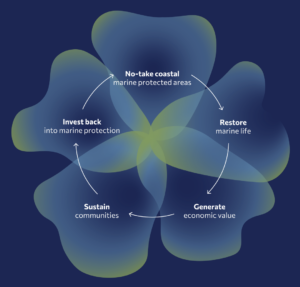
Our vision is for every coastal town to have its own MPA, bringing marine life back, directly supporting tourism and fishing, and the local people who depend on it.
Our mission is to help coastal communities create or improve marine protected areas as local regenerative businesses.
The opportunity is clear. The challenge is scaling it. And fast. Dynamic Planet published a study where we found that we need almost 190,000 coastal MPAs to achieve 30×30. With only five years to 2030, the world demands a new model for coastal prosperity, and our strategy is two-fold: create new, effective coastal MPAs that benefit marine life, people, the economy, and our climate; improve existing MPAs by ending destructive fishing practices like bottom trawling within their boundaries.
To address the barriers identified, Revive Our Ocean is built around three pillars:
As co-producers of Ocean with David Attenborough and other films promoting the benefits of effective marine protection for businesses including fishing and tourism, we are committed to creating media that inspires action.
Ocean with David Attenborough | Official Trailer | National Geographic
We support efforts to advance policy reform and facilitate pathways for scaling effective MPAs, working alongside local leaders, organizations, and movements to fast-track community-driven proposals.
We equip coastal communities, local governments and businesses around the world with the knowledge, tools, and networks needed to establish their own MPAs, restoring the ocean and allowing financial benefits and independence.
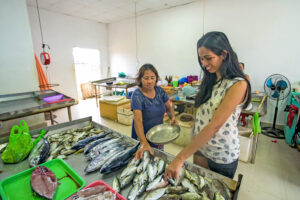
At the heart of Revive Our Ocean is its Collective, a growing group of organizations and leaders from around the world who are already successfully implementing marine protection. Initially active in the UK, Portugal, Greece, Türkiye, the Philippines, Indonesia, and Mexico, Revive Our Ocean Collective works directly with coastal communities, policymakers, and businesses to accelerate marine conservation and ensure effective, lasting ocean protection. The key ingredients of every Collective member organization are the same: visionary and relentless leadership; successful MPA as a proof of concept; ambition to scale; strong technical expertise; strong ties with the local community; and the potential for an enabling policy environment.
The Collective is a community of practice, where experienced practitioners guide others, share lessons, and adapt solutions to local contexts. We have found that no two coastlines are the same, but the principles of success are.
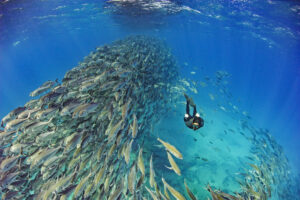
In just one year, Revive Our Ocean has been harnessing local leadership and building national momentum in seven countries, quantifying and qualifying the work, refining the ingredients to scale and rolling out assets, services and coordination provided by Dynamic Planet.
INSPIRE: Ocean with David Attenborough has been a worldwide success, bringing communities together. The Revive Our Ocean Collective is using this film and Revive Our Ocean short films, which relay the benefits of MPAs from community perspectives like fishers, tour operators, and local administrators, to show the benefits of MPAs to their community peers.
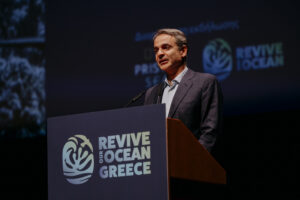
ENABLE: National leadership is awakening to the importance of community-led MPAs, like in the case of Greece where the Prime Minister is not only phasing out bottom trawling in MPAs in Greece by 2030, but has also called for coastal MPA proposals as the fishers of Amorgos proposed and created.
EQUIP: Revive Our Ocean is co-developing practical tools, guidance and resources to support communities through each step of MPA creation and implementation, including who should be involved, how the MPA should be designed, enforced, and monitored over time, and how it can be funded sustainably. Distributed and guided through the Revive Collective, local motivation will become effective, long-lasting marine protection benefiting local economies.
The coastal leaders we spoke to—fishers, scientists, tourism operators, and community advocates—are already doing this work: restoring marine life, strengthening local economies, and protecting what sustains them.
At Revive Our Ocean, our role is to support and scale these efforts—so the people closest to their waters have the power to secure and steward their own future.
Because when coastal communities lead, marine life returns, local economies strengthen, and a more resilient future takes shape that grows the roots for resilience —at the speed and scale required to achieve 30×30.
For more details, please see our Revive Our Ocean 2025 Impact Report and join us to revive our ocean, together!