
- MPA Handbook
- Chapter One
Why create a highly protected Marine Protected Area (MPA)? What are the benefits?
Learn about the many benefits of highly protected areas to marine life and people.
Benefits for nature
In the mid-1990s, Cabo Pulmo, in Mexico’s Gulf of California, was close to being an underwater desert. Back then, this wasn’t much different from the rest of the Gulf: a shadow of its former glory after too much fishing. The fishers there, frustrated with not having enough fish to catch, did something unexpected. Instead of spending more time at sea trying to catch the few fish left, they stopped fishing—completely. They convinced the Mexican government to create a national park in the sea, or a fully protected MPA, which was designated in 1995. Four years later, when scientists visited the park, not much had happened. But 10 years later, in 2009, they returned to see how the Gulf of California was doing. When they dived again at Cabo Pulmo, they could not believe what they saw. What had been a barren landscape a decade earlier was now a kaleidoscope of life and color.
In a single dive, they could see more sharks than the team had seen in the previous 10 years, along with aggregations of massive leopard groupers and Gulf groupers—large predators that are a sign of a very healthy ecosystem. After their SCUBA surveys and analyses, the scientists realized that the amount of marine life in the area had increased by five-fold in just a decade.1
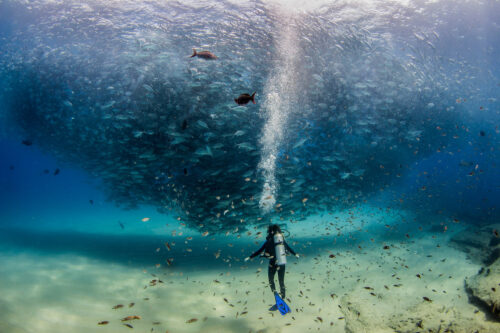
Photo credit: Jeff Hester
The good news is that Cabo Pulmo is not a rarity. This story of regeneration has happened all over the world, every time people have truly protected an ocean area. When we ban fishing and other damaging activities that we can control, the ocean bounces back to life—greater and faster than we could ever imagine.
Compared with nearby unprotected areas, MPAs can lead to:
1. More diverse marine life: When we protect certain ocean areas in MPAs, we usually see many different kinds of species return to living there, including those that are rare and endangered. This return happens mostly because populations of species that were depleted by fishing start coming back. In other words, MPAs support and promote high levels of biodiversity, the variety of life found in a particular area. Measures of biodiversity are fundamental for understanding ecosystem health. In addition to species diversity, genetic diversity within a species also increases in MPAs with more individuals and different types of habitats. Genetic diversity provides the raw material for adapting to global warming, diseases, and other stressors, and it is critical to protect.
2. More abundant marine life that produces more, healthier babies: Individual organisms in MPAs can live longer and get bigger inside MPAs as compared to outside areas. This is especially true for those marine species that were heavily fished (either as target species or in accidental catches, or “bycatch”) or otherwise impacted by humans. This changes the population so that there are more big, older individuals that produce many more eggs and larvae than the smaller individuals found in fished areas (Figure 8). They also often have better-quality eggs and offspring, so more of their babies survive. MPAs can also help protect marine life by protecting the areas where they spawn, which can be highly vulnerable to human impacts like overfishing. When the animals inside the MPAcan replenish their own population, their numbers increase and the offspring they produce can travel outside the protected area—sometimes over long distances. This can help replenish populations in other areas, a process known as “spillover” (see the “Benefits for people” tab).
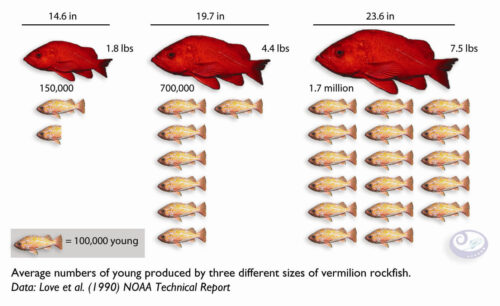
Figure 8. Average numbers of young produced by three different sizes of vermilion rockfish. Data: Love et al., 1990 NOAA Technical Report. Source: Partnership for the Interdisciplinary Studies of Coastal Oceans.
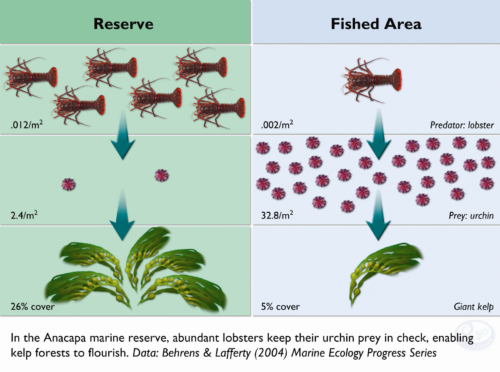
3. Reestablished natural connections between species: When marine life recovers in an MPA, species re-establish connections with each other. These connections can be those between predator and prey or competition for a resource. The biggest benefits usually happen when the marine life that recover have key roles in the ecosystem, such as top predators like sharks or species that create habitats, such as kelps or corals. As these species recover, their prey might become less abundant. This, in fact, shows that the whole ecosystem is recovering (Figure 9). Bringing back these natural interactions, along with larger populations and more genetic diversity, is likely to make the community in the MPA more resilient and better able to handle challenges.

Figure 9. Whole ecosystem recovery is facilitated by fully protected MPAs. Source: Partnership for Interdisciplinary Studies of Coastal Oceans (PISCO) Science of Marine Reserves: Mediterranean Booklet (2016) and US Booklet (2007).
4. Healthier and productive habitats: Marine life that forms habitats—like seagrass, corals, seaweeds, and oysters—can be some of the species that benefit most from MPAs. MPAs can protect against many of the most destructive human activities, such as dropping anchors on top of sensitive habitats, or using fishing gear that drags along the seafloor and destroys the complex and often very old marine communities in its path. As habitat-building species recover in MPAs, they can have a ripple effect throughout the ecosystem, helping other species to recover, too. Protecting “nursery” habitats like seagrass beds, mangroves, and reefs is particularly important for many species during early stages of life, when they rely on these habitats for shelter and food and are particularly vulnerable to human impacts.
5. Ecosystems that can handle, and help slow, global warming and ocean acidification: Healthy, intact ecosystems within MPAs can be more resilient to environmental change, which is something that an MPA cannot protect against directly. For example, data gathered since 2009 on the remote southern Line Islands, in the central Pacific, show that when reefs are fully protected and fish populations are robust, corals can rebound after extreme coral bleaching events. MPAs can also play a role in combating global warming and ocean acidification and its impacts, such as by boosting productivity, storing carbon in some marine habitats, and protecting human communities along coastlines from storms, high waves, and floods.
For more examples of the benefits of MPAs for nature, see the Case Studies section.
Citations
- Aburto-Oropeza, O. et al. Large Recovery of Fish Biomass in a No-Take Marine Reserve. PLOS ONE 6, e23601 (2011). https://doi.org/10.1371/journal.pone.0023601